The Complete Guide to Amazon Seller Fees
Knowing the ins and outs of Amazon seller fees is what can make or break your overall profitability. Take a deep dive into this complete guide.
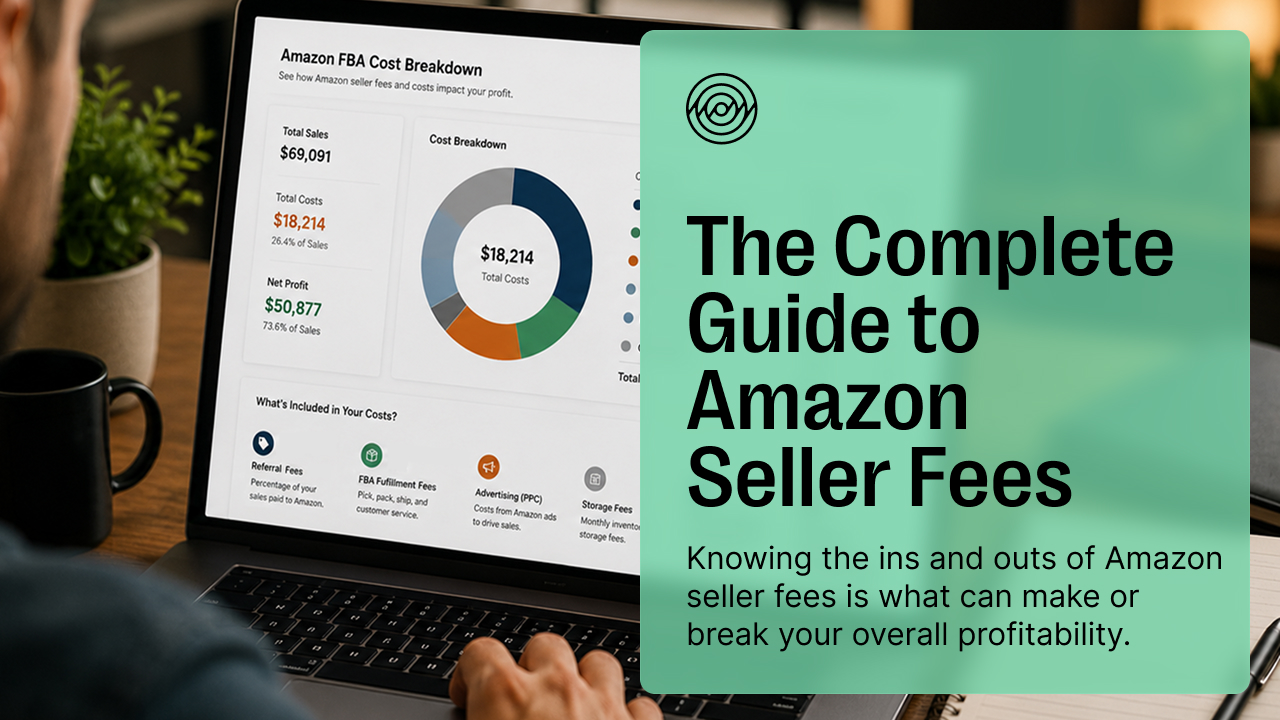
Amazon seller fees are the costs Amazon charges you for the privilege of selling on its platform. These include subscription fees, referral fees, fulfillment fees, storage fees, and a handful of situational charges that vary by product category, size, and fulfillment method. For any seller, understanding every line item is non-negotiable. Amazon seller fees directly determine whether your business is profitable or simply breaking even.
At AO2 Management, we work with Amazon sellers every day. The number one issue we see affecting margins isn't competition or advertising spend. In fact, it's sellers who don't fully understand the fee structure they're operating inside.
Types of Amazon Seller Fees
Amazon seller fees fall into three core buckets:
- Subscription/Account Fees: The base-level cost of having a seller account
- Transaction-Based Fees: Fees charged per sale (referral fees, closing fees)
- Optional Service Fees: FBA fulfillment, storage, and other add-on costs
Some fees are fixed. Some are percentage-based. Some are seasonal. Let's break each one down in detail.
Selling Plan Fees: Individual vs. Professional
The first Amazon seller fee you'll encounter is your selling plan fee, which is the account-level subscription that determines your access to Amazon's tools and features.
- Individual Plan: $0.99 per item sold. No monthly subscription. Designed for sellers moving fewer than 40 units per month.
- Professional Plan: $39.99 per month, regardless of how many items you sell. This is the right choice for any seller consistently moving more than 40 products monthly.
The math is straightforward: if you sell 41+ items a month, the Professional Plan saves you money immediately. Beyond the cost savings, the Professional Plan unlocks advanced advertising tools, bulk listing management, eligibility for the Buy Box, and the ability to set your own shipping rates.
Referral Fees: Amazon's Cut of Every Sale
The referral fee is the most universal Amazon seller fee. It applies to every item you sell, on every plan, through every fulfillment method. Think of it as Amazon's commission for connecting you with their customer base.
Referral fees are calculated as a percentage of the total sales price, including the item price, shipping, and any gift wrapping charges.
How much is the referral fee?
Most categories fall between 8% and 15%, but the range is wide. Here are some common examples:
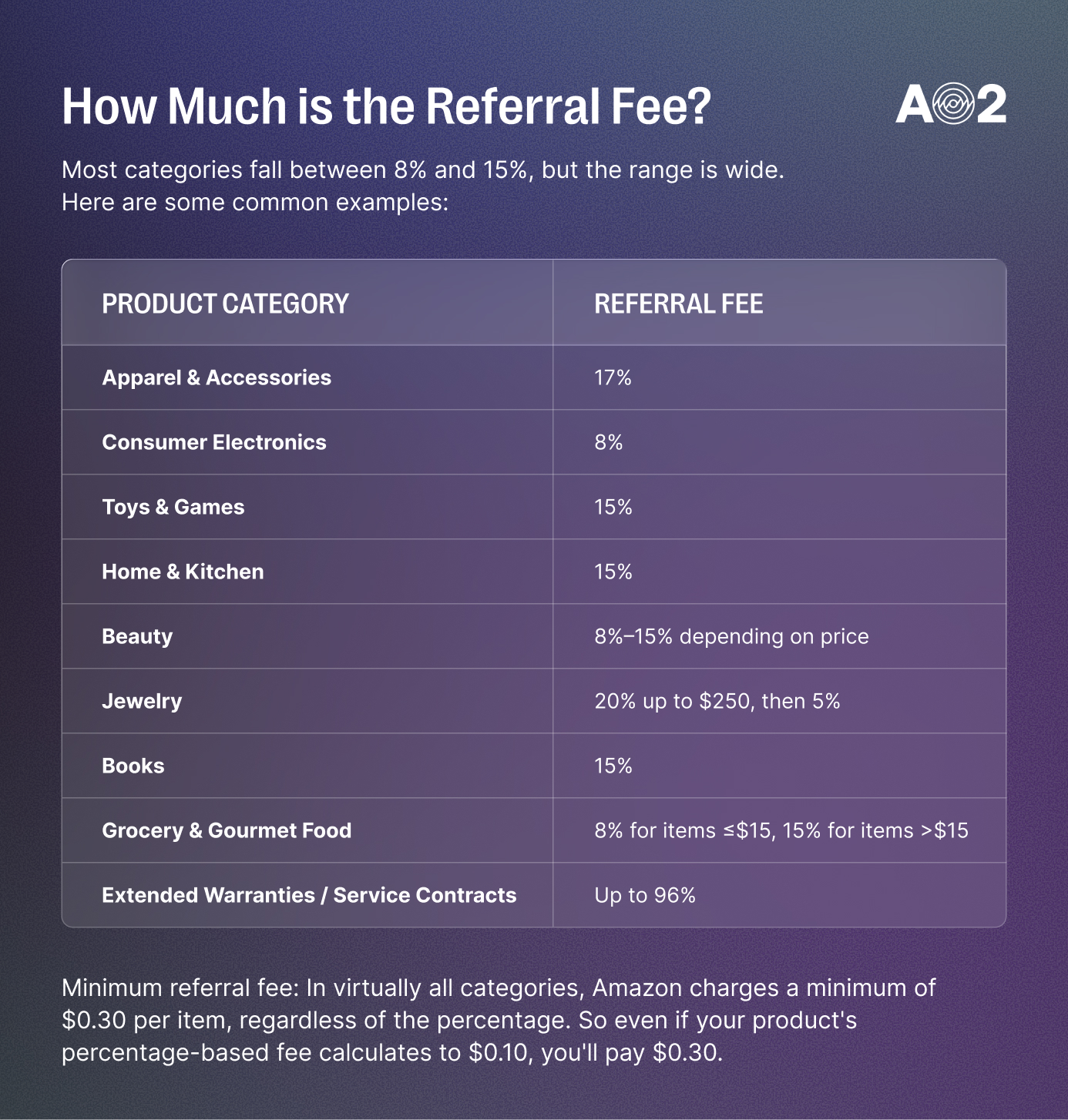
View the full Seller Central article on Referral Fees here.
Closing Fees: Additional for Media Category Sellers
If you sell in media categories (books, music, DVDs, video games, software, or similar), Amazon charges an additional $1.80 per item sold as a closing fee. This is on top of the referral fee.
This fee is fixed and non-negotiable. Media sellers should always factor this $1.80 per-unit charge into their pricing before listing.
FBA Fulfillment Fees
Fulfillment by Amazon (FBA) is one of the most powerful tools available to third-party sellers. It gives you access to Prime shipping, Amazon's logistics network, and hands-free order management.
FBA fulfillment fees are charged per unit and are based on:
- Product size tier (standard-size vs. large bulky vs. extra-large)
- Shipping weight (Amazon may use dimensional weight for lightweight, bulky items)
- Dimensional weight (used in place of shipping weight on some occasions)
- Fee categories (different categories come with different fulfillment fees)
- Time of year (peak season surcharges apply within Q4)
In addition to the outlined fees, Amazon has also enacted a 3.5% fuel and logistics-related surcharge to all FBA fulfillment fees as of April 17, 2026. Note that this percentage is calculated based on the FBA fee, not the cost of the sold item.
FBA Storage Fees: The Hidden Drain on Profitability
Storage fees are where many FBA sellers quietly hemorrhage money. Amazon charges you for the cubic footage your inventory occupies in its fulfillment centers, and the rates can jump significantly during the holiday (peak) season or if your inventory hasn’t moved in an extended period of time.
Aged Inventory Surcharge
Products sitting in Amazon's warehouse longer than 181 days (6 months) trigger an additional aged inventory surcharge. This fee escalates the longer your inventory sits, and it can quickly exceed the value of the product itself for slow-moving SKUs.
Tips to avoid storage fee overruns:
- Send inventory in smaller, more frequent batches
- Monitor your "Inventory Age" report in Seller Central weekly
- Run targeted promotions or coupons to move slow-moving stock
- Use Amazon removal orders to pull aging inventory before surcharges kick in
- Forecast based on 30/60/90-day sales velocity
Inbound Placement Service Fee
This is one of the newer fees Amazon has introduced, and it catches a lot of sellers off guard. When you ship inventory into Amazon's fulfillment network, Amazon decides how to distribute it across warehouses. If your shipment doesn't go to Amazon's preferred receiving location, you may be charged an inbound placement service fee.
The fee varies depending on the product size tier and the number of fulfillment centers involved in the distribution. The more spread out Amazon needs to send your inventory, the higher this fee.
How to reduce it: Amazon offers reduced inbound placement fees when you choose Amazon-optimized shipment splits or use their partnered carrier program.
Low Inventory Level Fee
Introduced in 2024, this fee penalizes FBA sellers who consistently maintain too little inventory relative to their sales velocity. Amazon implemented this to ensure their warehouses can meet Prime delivery promises, and they're holding sellers financially accountable for stockouts.
You are assessed a low inventory level fee when your historical days of supply falls below 28 days for products with high sales velocity. The fee is calculated per unit shipped. As of January 2026, this fee is calculated and enforced on a per SKU basis (rather than at the parent ASIN level).
The fix: Smarter inventory forecasting. Use your actual sales data to keep a healthy restock cadence. Most sellers who trigger this fee are either understocking intentionally to avoid storage fees or simply not watching their metrics closely enough.
Refund Administration Fee
When you issue a customer refund, Amazon returns only part of your referral fee. They keep a refund administration fee equal to the lesser of $5.00 or 20% of the referral fee you originally paid. This is to cover processing costs.
It's a small number per transaction, but for sellers with high return rates (especially in categories like apparel, electronics, or seasonal goods) it adds up very quickly.
High-Volume Listing Fee
Sellers with catalogs exceeding 1.5 million active SKUs (per marketplace) are charged a high-volume listing fee of $0.0001 per SKU per month for SKUs beyond the first 1.5M. This is rarely a concern for most sellers, but if you're managing an enormous catalog, it's worth factoring in.
Real-World Example: Total Amazon Seller Fees on One Product
Let's walk through a realistic cost breakdown for a private-label product: a set of silicone baking mats priced at $24.99, sold via FBA.
- Referral Fee (15% of $24.99) = $3.75
- FBA Fulfillment Fee (large standard, 12oz) = $4.55
- Monthly Storage Allocation (estimate) = $0.10
- Professional Plan Allocation ($39.99/1K units) = $0.04
- TOTAL AMAZON FEES = $8.44
- Net Payout to Seller = $16.55
That's roughly 33.8% of the sale price going to Amazon before you factor in your product cost, advertising spend, or shipping to FBA. This is why understanding Amazon seller fees is so critical before you set your price (and why working with an experienced account management partner makes a measurable difference).
How to Calculate Your Amazon Seller Fees
Amazon provides a built-in tool to help sellers estimate fees before they list a product.
Amazon's FBA Revenue Calculator allows you to enter a product ASIN or specify dimensions and category to get an estimated cost breakdown covering referral fees, FBA fees, and storage.
Strategies to Minimize Amazon Seller Fees
Understanding Amazon seller fees is only step one. Actively managing them is step two. Here are the most effective strategies:
- Right-size your inventory. Avoid both over-stocking (which triggers storage and aged inventory fees) and under-stocking (which triggers low inventory level fees). Data-driven forecasting is the only reliable solution.
- Optimize your product dimensions. Moving from one size tier to a smaller one can save dollars per unit in FBA fees. Sometimes minor packaging changes result in significant cost reduction at scale.
- Evaluate FBM for heavy or low-margin items. Fulfillment by Merchant gives you control over shipping costs for products where FBA fees erode your margins. The right fulfillment method depends on your product economics. You can also work with 3PL partners to optimize this as well.
- Use Amazon's partner carrier program. This reduces inbound shipping costs and can qualify you for reduced inbound placement fees.
- Monitor your fee reports in Seller Central. Amazon provides monthly fee breakdowns. Review them every month. Fees you don't notice compound silently.
- Enroll in FBA New Selection. If you're launching new products, this program waives several fees including monthly storage, liquidations, returns processing, and inbound placement for qualifying new ASINs.
Final Thoughts: Amazon Seller Fees Demand Active Management
Amazon seller fees are not a set-it-and-forget-it line item. They evolve (frequently). They have seasonal surcharges. They interact with your inventory levels, your product dimensions, and your category selection in ways that aren't always obvious. For sellers who track them closely, fees are a controllable variable. For sellers who don't, they're a slow leak that can quietly sink a business.
At AO2, we specialize in helping Amazon brands get full visibility into their fee structure, optimize their fulfillment strategy, and protect their margins as they scale (as just part of our services offered). Whether you're launching your first product or managing a seven-figure catalog, the right account management partner makes a measurable difference. Book a discovery call with our team today!
Latest Updates


Curious what AO2 can do for your brand? Schedule a call today.
.svg)


.webp)